Tumor Ablation (RFA / Microwave)
Advanced Minimally Invasive Thermal Ablation for Cancer Treatment. Tumor Ablation is a minimally invasive procedure that uses heat to destroy cancer cells without the need for open surgery. Radiofrequency Ablation (RFA) and Microwave Ablation (MWA) are image-guided thermal ablation techniques that allow precise destruction of tumors while maximizing preservation of surrounding healthy tissue.
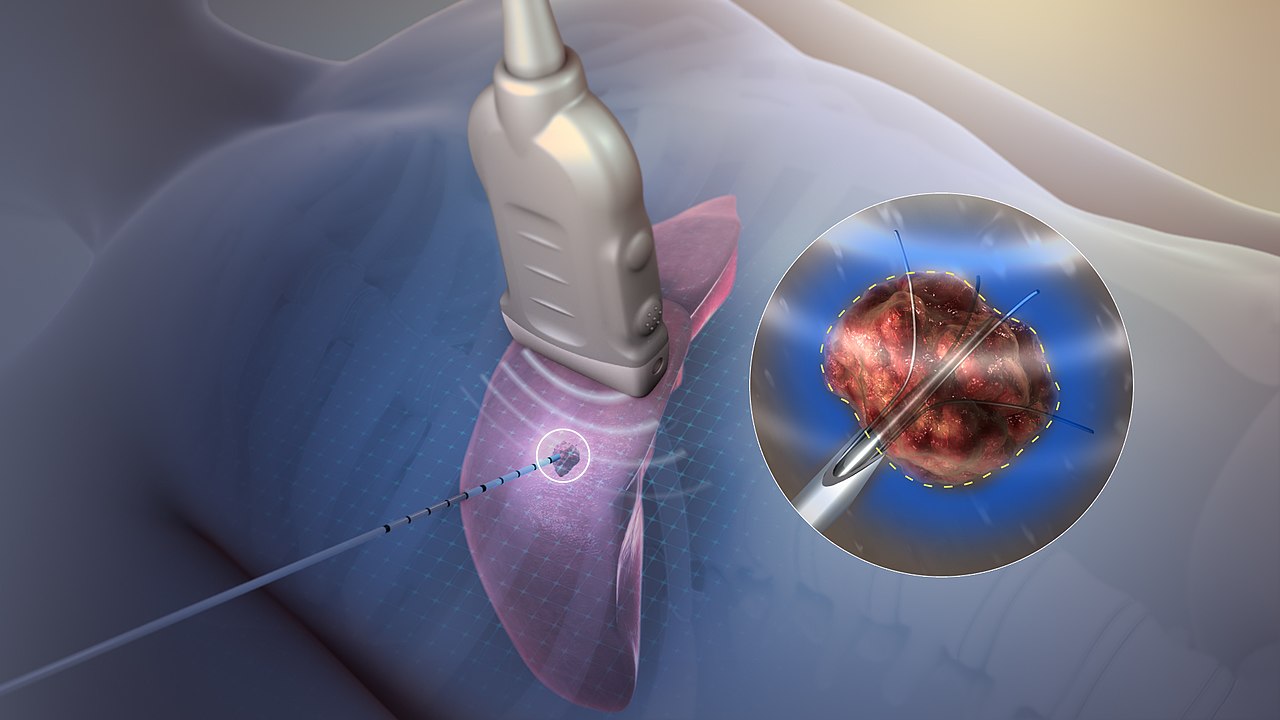
Thermal ablation allows minimally invasive destruction of tumors, with maximal preservation of surrounding healthy tissue, without the need for open surgery. Precise tumor ablation is possible today due to imaging expertise and image guidance technology that enable safe placement of specialized needles or probes into the tumors using ultrasound, CT, or MRI.
What is Tumor Ablation?
Tumor ablation is a procedure that uses extreme heat or cold to kill cancer cells. Radiofrequency Ablation (RFA) and Microwave Ablation (MWA) are the most mature and commonly utilized thermal ablation devices today. Both work based on heating to kill cancer cells.
In radiofrequency ablation, a needle probe under ultrasound, CT, or MRI guidance is inserted into the center of the tumor. An alternating current (oscillating in the radiofrequency spectrum) is applied through the needle, which passes through tissue to grounding pads. As the current passes into the tissue at the needle tip, ionic agitation creates frictional heating and tumor cells are killed.
Microwave ablation uses energy also within the radiofrequency spectrum but at a higher frequency. It works by direct oscillation of water molecules in tissue and heats faster and to hotter temperatures than RFA. There is no need for grounding pads.
Conditions Treated with Tumor Ablation
Our experts offer comprehensive image-guided techniques to treat cancers of:
- Liver cancer (hepatocellular carcinoma)
- Liver metastases (from colon, breast, lung cancer)
- Lung cancer
- Lung metastases
- Kidney cancer (renal cell carcinoma)
- Primary and metastatic solid tumors in soft tissues
- Bone tumors
- Musculoskeletal malignancies
For RFA, tumors cannot have a bigger diameter than 3.5 centimeters. For tumors that are 3.5 centimeters or bigger in the lung, liver, or kidneys, Microwave Ablation is offered.
Who is a Candidate for Tumor Ablation?
RFA is primarily used for patients who cannot have surgery due to cardiovascular problems, lung issues, or other conditions. Tumor ablation is ideal for patients with:
- Small tumors (up to 3.5 cm for RFA)
- Inoperable tumors
- Multiple tumors that can be treated simultaneously (MWA)
- Patients unfit for major surgery
- Early-stage liver cancer
- Metastatic disease confined to specific organs
- Patients seeking curative or palliative treatment
Types of Tumor Ablation
Radiofrequency Ablation (RFA)
Electrical Current Heating · Tumors ≤3.5 cm
An RFA uses heat to burn the cancer cells. A needle is inserted through the skin into the tumor, assisted by image guided techniques like ultrasound or CT scan and connected to a generator. The generator makes the cells vibrate. The heat caused by this vibration burns the cancer cells.
Microwave Ablation (MWA)
Microwave Energy Heating · Tumors >3.5 cm
For tumors in the lung, liver, or kidneys that are 3.5 centimeters or bigger, Microwave Ablation is offered. MWA is faster than RFA, destroying tumors more efficiently, and reducing the time patients remain under general anesthesia.
How Tumor Ablation is Performed
The procedure is performed under conscious sedation or general anesthesia with image guidance.
Procedure Steps
Minimally invasive · Image-guided
- Under CT guidance, a multiple array needle probe is inserted into the center of the tumor.
- After the individual electrodes are deployed from the hollow core of the needle, an alternating current is applied through the needle and electrodes.
- The tumor cells are killed as the current passes into the tissue at the electrode tips.
- To make sure all tumor cells are destroyed, the ablation is extended beyond the tumor margin by about 0.5 to 1.0 cm.
- The post-ablation lesion is larger than the original tumor size.
With microwave ablation, the probe produces intense heat that ablates (destroys) tumor tissue, often within 10 minutes.
Benefits of Tumor Ablation
Advantages of Microwave Ablation over RFA
Microwave ablation has several advantages when compared to traditional RFA:
- Speed: MWA is faster than RFA, destroying tumors more efficiently
- Simultaneous Tumor Ablation: Surgeons can ablate multiple liver tumors at the same time
- Larger Tumor Size: MWA can ablate larger tumors than are possible with RFA
- Higher temperatures: MWA heats faster and to hotter temperatures than RFA
- Shorter ablation times: MWA using advanced devices obtains shorter ablation times
- Larger ablation zones: MWA achieves larger ablation zones
Recovery After Tumor Ablation
After ablation, patients proceed to the post-anesthesia care unit for recovery. A post-procedure imaging scan may be performed to determine the effect of the ablation. Most patients are discharged home the same day or next day.
Post-procedure care includes:
- Antibiotics and/or pain medications may be prescribed
- First follow-up with CT or MRI by 1-3 months
- Surveillance every 3-6 months thereafter
- PET-CT is used in PET positive tumors such as colon cancer
- Strict follow-up is critical to detect residual or recurrent tumor when small
Risks and Side Effects
Risks include bleeding, infection, and rarely, damage to surrounding structures. Major complication rate is minimal at 1-3%.
- Bleeding at puncture site
- Infection
- Pain at treatment site
- Fever (post-ablation syndrome)
- Damage to surrounding structures (rare)
- Contrast dye reaction (if imaging contrast used)
Success Rate of Tumor Ablation
The ablation lesion eventually shrinks into a much smaller scar if there is no recurrence . Strict follow-up is critical as residual or recurrent tumor should be detected when they are still small, when another simple percutaneous ablation could be performed without much additional risk .
Why Choose Our Tumor Ablation Program?
Our interventional radiologists specialize in image-guided thermal ablation using the latest RFA and microwave technology to treat various solid tumors with minimal invasiveness.
Ready to Consult Dr. Tejendra Ramani?
Book your appointment today and get expert vascular care in Kutch.

Dr. Tejendra Ramani
Consultant Interventional Radiologist
Vascular · Neuro ·
Image-Guided Interventions
MD (Gold Medalist) Neuro & Vascular Interventional Specialist NIMHANS-trained Neuro Intervention, PhD Scholar
View Full Profile